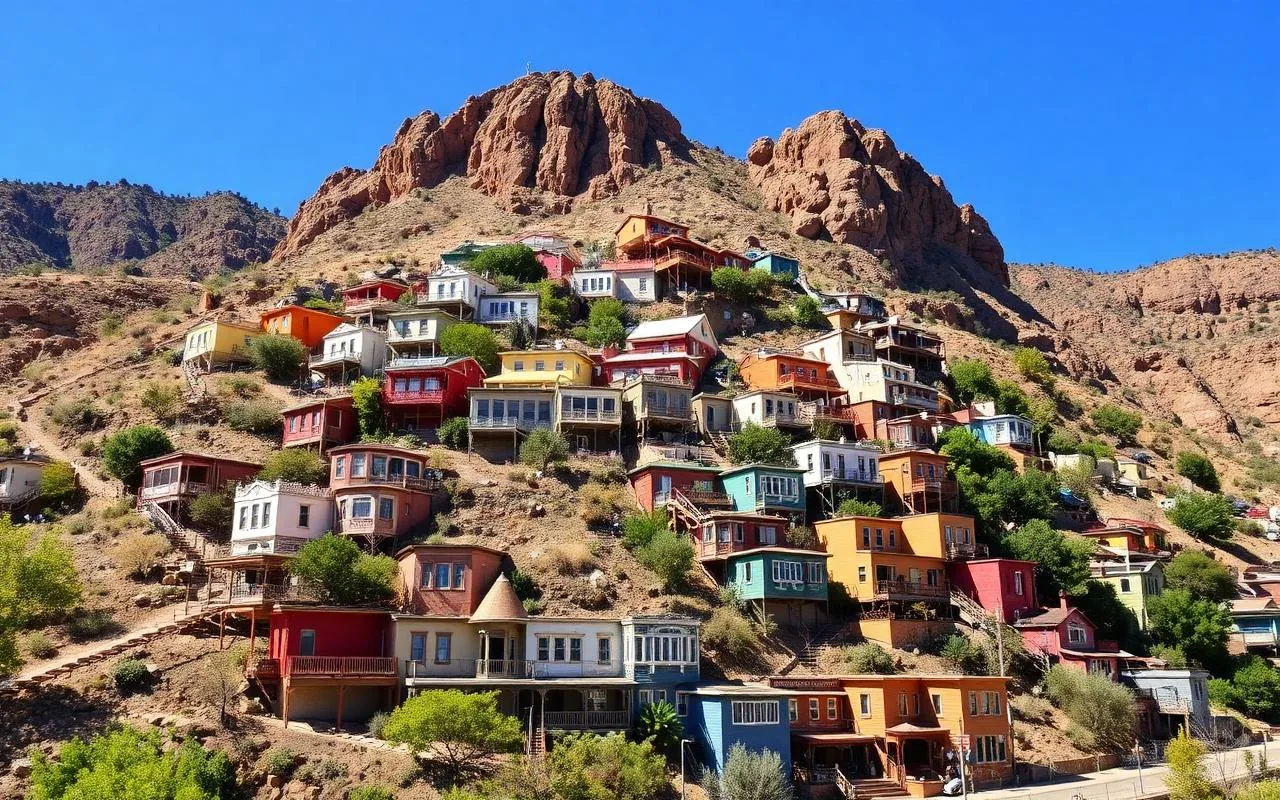
Bisbee is the Arizona town I send people to when they tell me they've already done Sedona, Tucson, and the Grand Canyon and want something different. Nothing about Bisbee is what you expect a southern Arizona town to be. It's tucked into the Mule Mountains a mile from the Mexican border, built into the impossibly steep walls of Tombstone Canyon, and it's been a working bohemian artist colony since the 1970s when the copper mines closed and hippies bought the abandoned Victorian houses for almost nothing.
Walking Brewery Gulch on a Saturday afternoon, you'll pass a 130-year-old saloon, an opera house, three art galleries, a vegan bakery, and a guy with a parrot on his shoulder. The whole place feels like an alternate-timeline version of San Francisco's Haight from 1972, except smaller and less self-conscious. People here moved to Bisbee because they wanted to live somewhere that hadn't been smoothed over.
Most Arizona travelers never make it down here — Bisbee is 3.5 hours from Phoenix and 1.5 hours from Tucson, deep enough into the southeastern corner of the state that you have to make a choice to come. But it rewards the drive more than almost anywhere else in Arizona. Here's how to do a first visit well.
A little context: how Bisbee became Bisbee
Bisbee was a copper mining town starting in the 1880s. At its peak in the early 20th century, it was the largest city between St. Louis and San Francisco — more than 20,000 people, with electric streetlights, multiple newspapers, an opera house, and the most ornate Victorian residential architecture in the Southwest. The Copper Queen Mine produced billions of dollars of copper, silver, and gold.
When the underground mines closed in 1975, Bisbee almost died. Population collapsed below 6,000. Beautiful houses on impossibly steep hillsides sat empty. Then artists, writers, and counter-culture refugees from California started showing up, attracted by $5,000 Victorians and the wild beauty of the canyon. They never really left. Today's Bisbee is what happened next: a working town of about 5,000, with one of the densest concentrations of artists, galleries, and odd small businesses anywhere in the state.
Understanding this story makes the visit better. The colorful houses cantilevered over Tombstone Canyon, the old miners' tunnels under your feet, the way Brewery Gulch curves up the hill — it all makes more sense once you know what the town used to be and what it became.
What to do: the essentials
Start with the Queen Mine Tour. You ride a small mining train more than 1,500 feet horizontally into the mountain, led by retired miners (many of them who actually worked these tunnels). The temperature drops 20°F when you go underground, the air smells like wet rock, and the stories are direct from the people who lived them. It's an hour and a half, costs around $14, and is genuinely the best mine tour I've done in the Southwest.
After the mine, walk the historic downtown. Main Street is one short hill of galleries, antique shops, and old hotels. Don't miss the Lyric Theatre (a 1908 vaudeville house still operating as a small cinema), the Copper Queen Hotel lobby (1902 — even if you're not staying there, walk inside and look up), and 55 Main Gallery. Brewery Gulch is the parallel street one block up the hill, with the bars and live-music venues.
If you're up for a workout, climb the Bisbee 1000 Stair Hike — a circuit of 9 historic public staircases that connect the neighborhoods cascading up the hillsides. It's about a mile of horizontal distance and a thousand stairs of vertical work. Stunning views, and the city holds an annual race up the stairs every October.
Where to eat
Cafe Roka is the destination dinner. Four-course prix-fixe Italian-inspired menu, in a converted historic building with proper white tablecloths and a thoughtful wine list. It's the one reservation you should make before driving down. Closed Sunday through Tuesday — plan around it.
For breakfast, the Bisbee Breakfast Club is the institution. The chilaquiles are legendary, the line moves fast even when long, and the portions assume you've been working in a mine for eight hours. It's worth eating here both mornings of a weekend trip.
For casual: Screaming Banshee Pizza (excellent woodfired pies), Old Bisbee Brewing for the local craft beer, and Bisbee Coffee Company for proper espresso. The Bisbee Farmers Market on Saturday mornings is small but lovely.
Where to stay
The Copper Queen Hotel (1902) is the iconic stay. Period rooms, a haunted-hotel reputation, a working saloon downstairs, and the kind of creaky charm that's hard to manufacture. Rooms vary wildly — some are tiny and quirky, some are spacious and proper. The Letson Loft (above an old store on Main Street) is the boutique alternative.
Most of Bisbee's best lodging is actually in private Victorian houses converted to vacation rentals. Dozens of them are available on Airbnb and VRBO, scattered across the hillside neighborhoods. Renting one is the right call for a 2- or 3-night stay; staying in a 110-year-old house with a tin ceiling and a view across the canyon is part of the Bisbee experience.
When to go and how to plan it
October through April is the comfortable window — Bisbee sits at 5,500 feet so summers are warm but not Phoenix-warm. Summer is fine too, with afternoon thunderstorms providing dramatic skies. Fall is my favorite season; the canyon walls hold the late light beautifully and the town isn't crowded.
Day trips work but undersell the place. The drive from Phoenix is 3.5 hours one way; from Tucson it's a manageable 1.5 hours. A 2-night weekend is the right minimum to actually feel Bisbee instead of just touring it. Combine with Tombstone (45 minutes north), Coronado National Memorial (45 minutes south), or Chiricahua National Monument (90 minutes east) for an excellent southeastern Arizona road trip.
Frequently asked questions
How far is Bisbee from Tucson?
About 1 hour 40 minutes via I-10 and AZ-80, roughly 95 miles southeast. From Phoenix it's about 3.5 hours.
Is Bisbee worth visiting?
Yes, especially if you like art, history, or genuinely unusual small towns. It is one of the most distinctive places in the state, and visitors who give it a full weekend almost always come back.
Is Bisbee safe?
Yes. It's a quiet, friendly town with low crime. The proximity to the border (about a mile from Naco) sometimes worries first-time visitors, but it doesn't really affect daily life in Bisbee.
Is Bisbee walkable?
The historic downtown is very walkable, but be ready for hills. The town is built on the side of a canyon and even short distances often involve stairs.