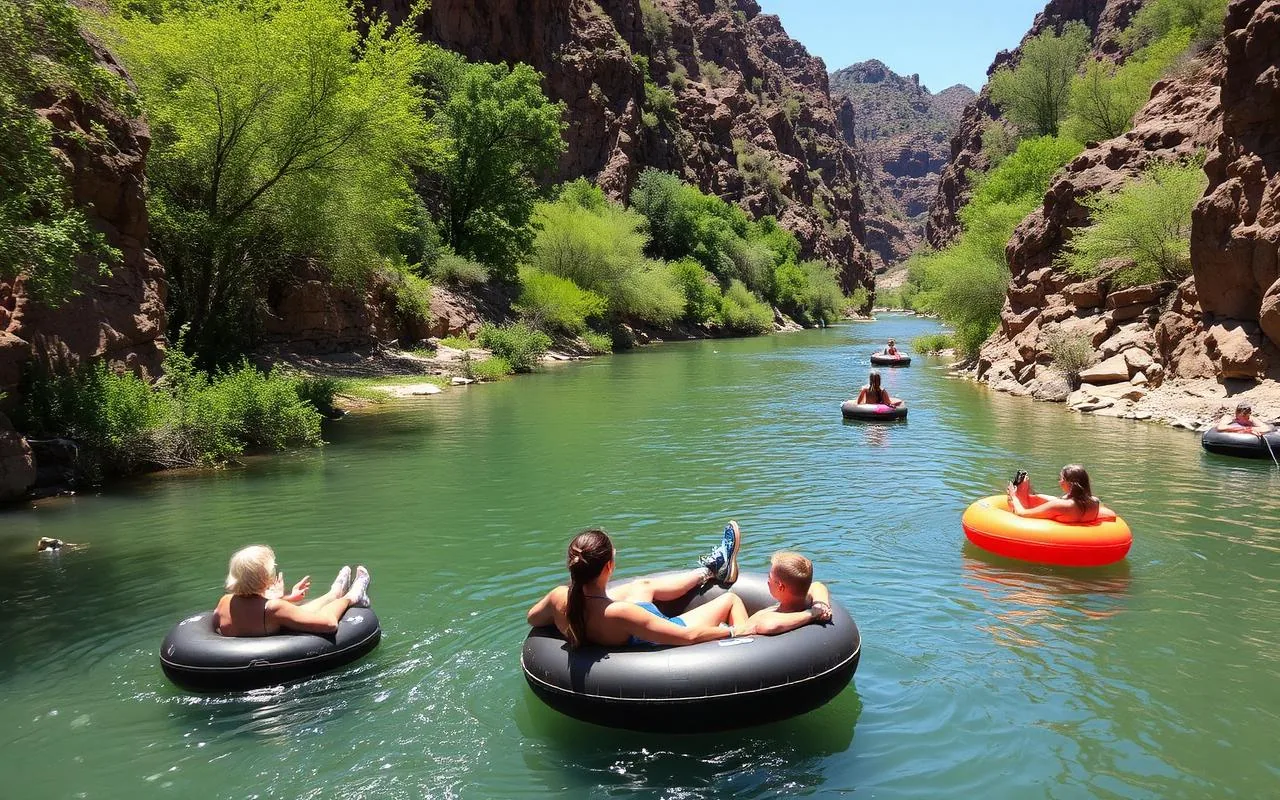
If you've lived in the Phoenix area for more than one summer, somebody has invited you tubing on the Salt River. I held out for years because the photos always looked, frankly, kind of chaotic — packs of people in pool tubes, beer cans floating past wild horses, the whole spring-break energy of it. When I finally went, on a Tuesday morning in late June with my sister and two friends, I felt a little foolish for having waited.
The Salt River, the part of it that runs through the Lower Salt River Recreation Area east of Mesa, is improbably green. Cottonwood trees lean over the banks, ducks and herons drift by, and on the right day you'll round a bend and see a band of wild horses standing in the shallows drinking. The water is cold enough to be honestly refreshing in 110°F heat, and the float is slow enough that you can have a long conversation without paddling once.
But there are things first-timers consistently get wrong — sunburns that last a week, lost car keys, soft coolers that flip and dump everything they own into the river. After several seasons of going at least once a summer (and bringing first-timers along almost every time), here's the full primer I wish someone had handed me at the start.
The basics: who runs it, when, and how
Salt River Tubing — the official outfitter, in a low building on Bush Highway — operates from roughly Memorial Day through Labor Day, weather and river flow permitting. They are the only legal rental operation in the recreation area, and unless you own your own tubes and arrange your own shuttle, you'll be working with them.
The setup is simple. You park, pay (cash is fastest), get tubes, and ride a school-bus shuttle to one of four put-in points. From there you float back to the parking lot. Different put-ins give you different float lengths: Bridge Two is roughly 2 hours, the Pebble Beach put-in is 3, the Water Users put-in is around 4, and the Bush Highway put-in is a full 5 hours on the water.
First-timers tend to overestimate their stamina. A 5-hour float in the sun is genuinely a workout — even though you're sitting in a tube, the cumulative exposure wears you out. For a first trip with friends who aren't endurance athletes, the 3-hour float is the sweet spot. Save the 5-hour for once you know what you're signing up for.
What to bring (and what they'll absolutely confiscate)
Pack lighter than you think you need to. Anything that goes on the river either has to clip to your tube, ride in your cooler, or be tied around your wrist. Bags get dropped. Sunglasses go overboard. The river is shallow but the bottom is sandy and forgiving — you will not find what you lose.
The most important non-obvious item is a second tube specifically for your cooler. Salt River Tubing rents these, but a lot of locals bring their own. Use a hard-sided cooler with a tight latch — soft coolers and styrofoam coolers are banned, and the rangers genuinely enforce it. Glass is also banned, no exceptions. Stick to cans for drinks and Tupperware for food.
Other essentials: water shoes you do not love (river shoes get destroyed by the rocks and sand — Tevas with a buckle are the local uniform), reef-safe sunscreen applied before you launch and again at the halfway mark, a dry bag for your phone and car key, a hat with a string, and at least one bottle of plain water per person. The alcohol is fine in moderation but it dehydrates fast in the desert sun.
- Hard-sided cooler with a tight latch — soft and styrofoam are banned
- Water shoes with a strap or buckle (no flip flops)
- Reef-safe sunscreen + a hat with a string
- Dry bag for phone and keys
- Cans only — glass is banned and they enforce it
- Cash for parking and rentals
The wild horses: please, the rules exist for a reason
The Salt River wild horses are the most famous wildlife in the Valley, and meeting them on the river is genuinely one of the most magical things you'll do in Arizona. They are also wild animals on federally protected land, and there are real rules.
Federal regulation requires a 50-foot distance. That means no selfies-with-the-horse, no hand-feeding, no trying to herd them into a better photo composition. Even more importantly: do not throw food into the river. People throw apples and carrots in thinking they're being generous, and the salt and bacteria in the water have made horses sick and even killed them. If you see somebody doing this, it's okay to politely speak up.
If a horse approaches your group on its own (which sometimes happens), the right move is to drift quietly past. Don't paddle toward it, don't splash, don't try to touch it. The horses tolerate humans because humans have mostly behaved well around them. Keep it that way.
Timing your float: when to go and when to skip it
Weekdays are dramatically better than weekends. A Tuesday or Wednesday morning float feels almost solitary, with herons in the trees and maybe three other groups in eyesight. A Saturday in July is wall-to-wall tubers, with a party energy that's fun if you're in the mood for it and overwhelming if you're not.
Time of day matters too. The first shuttle of the morning (usually 9 AM) drops you on water that's still in shade, the air is cooler, and the river is at its calmest. Mid-afternoon floats run into the worst sun and the thickest crowds. If you're going on a weekend, get to the parking lot before it opens — by 10 AM on a hot Saturday the line snakes around the building.
Skip the river entirely after a monsoon storm. Heavy rain in the Salt River watershed turns the river brown and fast, and the outfitter will close on its own when conditions are dangerous. Always check the Salt River Tubing website the morning of your trip.
Making it a full day in the East Valley
After 3 hours on the water, you'll be hungry, sunburned, and a little wobbly. The closest reliable post-float meal is Pedersen's Wing-It in Mesa, which is unapologetically a wing place and exactly what you want. For a slightly nicer reset, drive 25 minutes into Old Town Scottsdale for tacos and air conditioning at Diego Pops or El Hefe.
If you still have energy, the Butcher Jones Recreation Area on Saguaro Lake is a 15-minute drive from the tube lot and has a calm swimming beach. We've made a full Saturday of tubing in the morning and Saguaro Lake in the late afternoon more than once.
Frequently asked questions
How much does Salt River tubing cost?
Tube rental is around $20 per person, with a separate small charge for a cooler tube. There's also a Tonto National Forest day-use parking fee. Bring cash — the line moves much faster.
Can kids do Salt River tubing?
Yes, but it's better suited to age 8 and up, and life jackets are smart for anyone uncertain in water. The shorter 2-hour Bridge Two float is the most family-friendly option.
Is the Salt River safe to swim in?
It's generally fine for healthy adults, but it's a natural river — don't drink it, don't swim with open cuts, and shower when you get home. Skip the float if you have an immune condition.
What if I can't swim?
The float passes through some shallow rocky stretches and some deeper pools. Non-swimmers should wear a life jacket the entire time. The outfitter rents them.