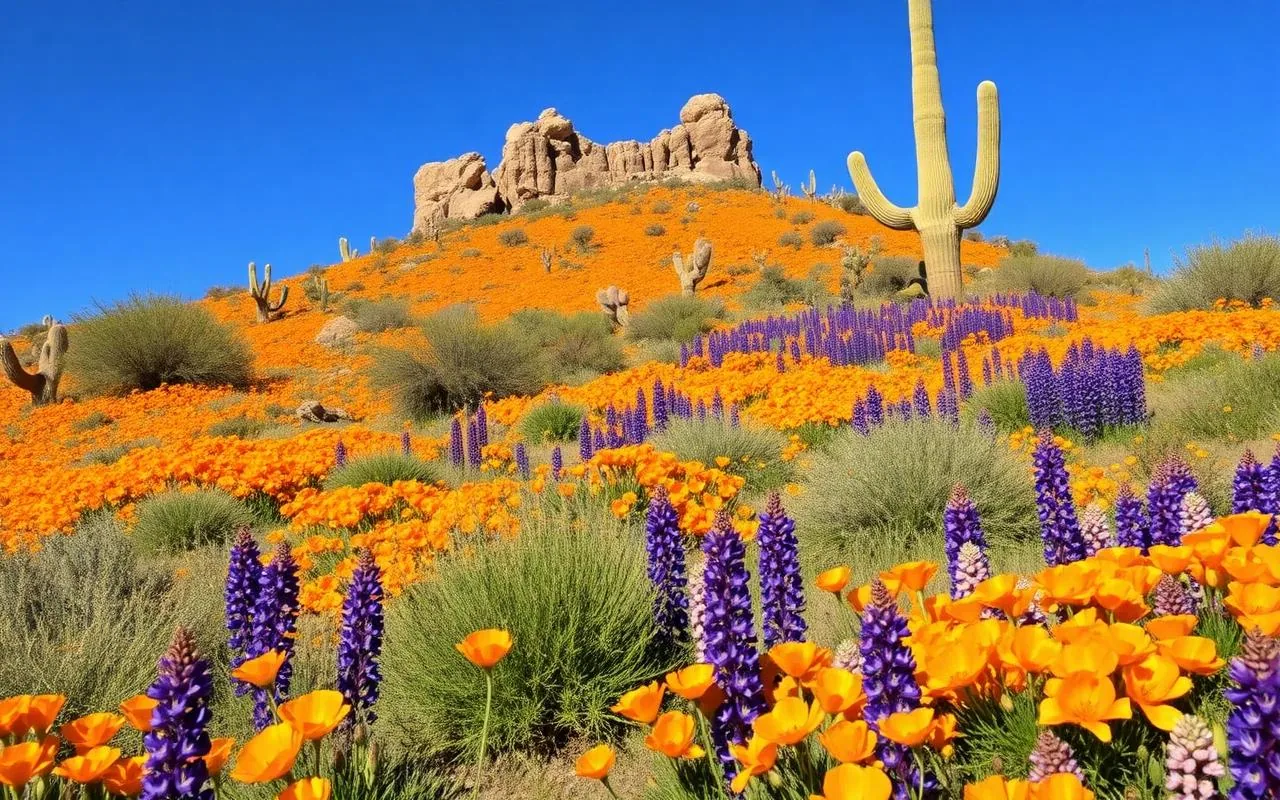
I'll never forget my first Arizona wildflower season. I'd moved here in October and spent the first few months thinking I'd made a terrible mistake — the desert in winter is brown and tan and quiet, and I missed seasons. Then in early March, after a wet winter, I drove out to Picacho Peak for a hike. Coming around a bend on I-10, I saw an entire hillside on fire with orange poppies. I pulled over onto the shoulder and just stared. I had not understood that the desert was capable of this.
Arizona wildflower season is one of the most magical things about living here, but it's also frustrating in a specific way: it's unpredictable. The exact timing and intensity depend almost entirely on winter rainfall patterns. A great superbloom year, like 2019 or 2023, brings hillsides carpeted in orange poppies, purple lupine, yellow brittlebush, and white desert chicory for 3 or 4 glorious weeks. A dry year barely happens at all.
Here's everything I've learned about predicting, chasing, and photographing the bloom — across many years of trying, succeeding, missing it, and occasionally driving 90 minutes to a hillside to find nothing but green.
How to predict a good bloom year
Three things determine whether you'll get a superbloom: winter rainfall, winter temperature, and timing of warming in spring. Desert annuals need a soaking by November to germinate. They need consistent cool moisture through December and January to grow. And they need gradual warming, not a sudden March heat wave, to flower simultaneously across a hillside.
Practically, the threshold most wildflower watchers use: at least 4 inches of rainfall across November–February at low desert sites, and ideally a cool early March. The Desert Botanical Garden in Phoenix publishes a 'bloom forecast' in late January that aggregates these signals — it's the most reliable single source. The Arizona-Sonora Desert Museum and the Saguaro National Park rangers also post regular updates in the weeks before peak bloom.
Even in mediocre years, smaller blooms happen reliably at higher elevation sites (Catalina State Park, the Superstitions) because moisture lingers there longer. So if the low desert is a bust, don't give up — try a few thousand feet higher.
The best places to see wildflowers
Picacho Peak State Park is the most famous and most reliable. The west-facing slopes off I-10 (about halfway between Phoenix and Tucson) put on the densest poppy display in the state in good years. Park at the main trailheads, walk the Calloway Trail, and the bloom is genuinely overwhelming. Go on a weekday — weekend traffic gets ridiculous during peak.
Lost Dutchman State Park, in the Superstitions east of Phoenix, is the other reliable performer. The wildflower show here is mixed — poppies, lupine, owl's clover, and globe mallow under massive saguaros, with the Superstition Mountains rising behind everything. The Treasure Loop Trail is the easiest way to see it. Stunning.
Bartlett Lake (northeast of Phoenix) has quieter but equally beautiful displays, especially the area around the lake's access road. Catalina State Park north of Tucson has lower density but the wildflowers-under-saguaros combination is iconic. The Bajada Loop Drive in Saguaro National Park West offers a windshield-tour version of the bloom if you don't want to hike.
Hidden gem: the Black Hills back roads near Wickenburg, off the Route 89 corridor. Almost no tourists, and in good years the lupine fields rival anything south of San Francisco.
Timing the bloom
Peak bloom for the low desert (Picacho, Bartlett, Saguaro West) is usually the first two weeks of March, sometimes extending into late March in cool springs. Higher elevation sites (Lost Dutchman, Catalina, the Superstitions) peak a week or two later — typically mid-March to early April.
The window is short. A hillside that's solid orange this Saturday can be 70% gone the next Saturday if it gets hot. If you're traveling specifically for the bloom, build flexibility into your dates and follow the Desert Botanical Garden's weekly updates closely.
Photography tips
Morning light is dramatically better than midday. Poppies open with the sun, and they're at peak openness from about 10 AM to 2 PM — but the light from 8–10 AM is so much softer and more flattering. Plan to be on a trail by sunrise for the best combination.
Get low. The iconic shots aren't from standing height. Lying on your stomach and shooting through the flowers (with a hillside of more flowers in the background) is the technique. A small tarp keeps you from coming home with rocks in your pockets.
Phones do surprisingly well in this light, especially in portrait mode. If you're using a real camera, a moderate zoom (50–85mm) lets you compress the hillside and make the bloom look even denser than it is. Avoid wide angle for landscape shots — it spreads the flowers out and the hillside looks sparse.
Etiquette: please do not be the person
Stay on trails. Every year, people trample wildflower fields trying to set up the perfect Instagram shot, and the damage is real — these are annual plants and you're crushing next year's seed bank. Stay on designated paths. Do not pick flowers — many wildflowers are protected and picking is a fineable offense in state and federal parks.
Drones are prohibited in all Arizona state parks and national park sites. Don't be the person whose drone gets confiscated. Same with leaving the road for that perfect shot of your truck in a poppy field — it's wrecking the place for everyone behind you.
Frequently asked questions
When is wildflower season in Arizona?
Late February through mid-March for the low desert, extending into early April at higher elevations. Peak bloom is usually the first two weeks of March in a good year.
Where can I see poppies in Arizona?
Picacho Peak State Park is the most reliable, with dense hillsides of orange Mexican gold poppies in any decent rainfall year. Lost Dutchman State Park, Bartlett Lake, and Catalina State Park are close runners-up.
How do I know if it'll be a good superbloom year?
Check the Desert Botanical Garden's bloom forecast, which is updated in late January and again through February. They aggregate winter rainfall and temperature data into a usable prediction.
Is it legal to pick Arizona wildflowers?
No. Picking is prohibited in all state parks, national parks, and most public lands. Some wildflowers (including Arizona poppies) are protected by state law even on private property.